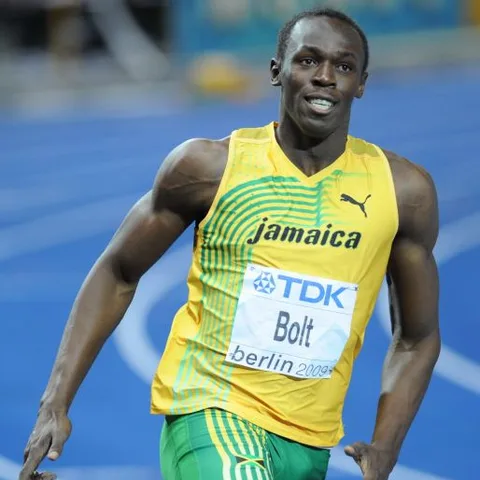
Usain Bolt is a retired Jamaican sprinter widely regarded as the greatest of all time and the fastest man ever timed, holding the world records in the 100 metres and 200 metres and winning eight Olympic gold medals across three consecutive Games. His combination of towering stride length, charisma and dominance reshaped the public profile of track and field.
Early life in Jamaica
Usain St Leo Bolt was born on 21 August 1986 in Sherwood Content, a small town in the parish of Trelawny in northwestern Jamaica. He grew up in a rural community where his parents ran a local grocery store, and as a child he was drawn to cricket and football as much as to running.
At William Knibb Memorial High School his cricket coach noticed his exceptional speed and encouraged him to concentrate on sprinting. By his mid-teens Bolt was already a standout junior. Competing at the 2002 World Junior Championships held in Kingston, he won the 200 metres in front of a home crowd, becoming a notably young champion at that level and announcing himself as a major prospect.
Rise to the top
Bolt turned professional in the early 2000s and initially focused on the 200 metres, the event in which he first made his name. Injuries and inconsistency limited his early senior seasons, and his progress in the longer sprint came before he committed fully to the 100 metres.
His breakthrough at the shorter distance arrived in 2008. That season he ran a string of remarkable times and entered the Beijing Olympics as a genuine contender rather than a clear favourite. What followed turned him into a global figure, as he combined the 100m and 200m in a way few sprinters had managed at the very highest level.
Bolt trained for much of his career under coach Glen Mills with the Racers Track Club in Jamaica, a programme that became central to his longevity and his ability to peak at major championships.
Part of what made his rise so striking was that the 100 metres had long been seen as the preserve of more compact, explosive athletes. Bolt's emergence as a tall sprinter who could dominate the shortest event, having come to it from the 200 metres, ran against conventional thinking about the discipline and forced a rethink of what an elite sprinter could look like.
Peak achievements and records
At the 2008 Beijing Olympics Bolt won the 100m, the 200m and, with the Jamaican team, the 4x100m relay, setting world records in the individual events. He repeated the sprint sweep at London 2012 and again at Rio 2016, an unprecedented run of dominance across three Olympic Games.
His world records were set at the 2009 World Championships in Berlin, where he ran 9.58 seconds in the 100 metres and 19.19 seconds in the 200 metres. Both marks still stand and remain the benchmark times in sprinting. He also collected a large haul of World Championship gold medals over his career.
One relay medal from Beijing was later reallocated after a teammate's doping case, which adjusted his final Olympic gold tally; his individual records and titles were unaffected.
- 100m world record holder, 9.58 seconds (Berlin, 2009)
- 200m world record holder, 19.19 seconds (Berlin, 2009)
- Eight Olympic gold medals across 2008, 2012 and 2016
- Multiple World Championship titles in the 100m, 200m and relay
- Olympic 100m/200m double won at three consecutive Games
Running style and presence
At around 1.95 metres tall, Bolt was unusually large for an elite sprinter, and his height gave him an exceptionally long stride. Where rivals needed more steps to cover the track, Bolt covered the 100 metres in markedly fewer, a feature that became central to analyses of his speed.
His relaxed starts, where he was often behind at the first transition before powering through the second half of a race, became a signature. So did his showmanship, including his "To Di World" lightning-bolt pose, playful interactions with crowds and cameras, and a charisma that drew audiences far beyond traditional athletics fans.
Life after athletics and impact
Bolt retired from competitive athletics following the 2017 World Championships in London. Since retiring he has pursued business and ambassadorial ventures, made brief and well-publicised attempts at professional football trials, and remained a prominent global sports personality.
His legacy rests on both performance and popularity. He elevated sprinting's profile during his peak years, his world records have proved durable, and he is routinely ranked among the most recognisable athletes of his era alongside figures such as Michael Phelps. For Jamaica, a small nation with a deep sprinting tradition, he became a defining national icon.
Frequently Asked Questions
What are Usain Bolt's world records?
Bolt holds the men's 100 metres world record of 9.58 seconds and the 200 metres world record of 19.19 seconds, both set at the 2009 World Championships in Berlin. Both marks still stand.
How many Olympic gold medals did Usain Bolt win?
He won eight Olympic gold medals across the 2008, 2012 and 2016 Games. His total was adjusted after a relay medal from Beijing was reallocated due to a teammate's doping case.
Where is Usain Bolt from?
He was born on 21 August 1986 in Sherwood Content, in the parish of Trelawny, Jamaica, where his parents ran a grocery store.
What events did Usain Bolt compete in?
His main events were the 100 metres and 200 metres, plus the 4x100 metres relay with the Jamaican team. He first made his name in the 200 metres before adding the 100 metres.
Why was Usain Bolt so fast?
Standing around 1.95 metres tall, he had an unusually long stride for a sprinter, covering the 100 metres in notably fewer steps than rivals while maintaining a high stride frequency.
When did Usain Bolt retire?
He retired from competitive athletics after the 2017 World Championships in London.
Did Usain Bolt try other sports?
After retiring from athletics he made publicised attempts at professional football trials with several clubs, though he did not establish a football career.